
About Shake-A-Leg Miami
A universally accessible watersports center on Biscayne Bay — a 1932 seaplane hangar, a dock you can roll onto, and whoever is on the water that day. Here since 1990.

Our Mission, Vision & Approach
We're on a mission to utilize the marine environment to improve the health, education, and independence of children and adults with physical, developmental and economic challenges, in an inclusive community setting.
Our vision is to be the premier global community where people with disabilities, their families and members of all ages and abilities have fun, are inspired, make friends and launch dreams through sailing and water sports. People with disabilities want leisure, friendship and a place in their community just like everyone else, and our sailors, campers, mentors and veterans build independence, confidence and fitness on the water.

Our Team
Meet the team that keeps us shaking every day — the staff and board who run the docks, the camps and the boats. Several of them arrived here as campers or volunteers and never really left.

Our Universally Accessible Fleet
Sailors with disabilities need specially designed boats and kayaks that add stability, agility and mobility aboard a vessel. Here's how we do that.

A Rich History of Impact
Since 1990, Shake-A-Leg Miami has helped people of all ability levels enjoy the sea — from a 1932 Coast Guard seaplane hangar to more than 30,000 visits a year on Biscayne Bay.
How it started
Harry Horgan, our co-founder and CEO, started Shake-A-Leg Miami in 1990 with his wife Susie and others. Harry grew up sailing in Rhode Island and was paralyzed in a car accident at 22. He and Susie moved to Miami, where a program of sailing for people with disabilities could run throughout the year with fewer weather disruptions.
Milestones
- 1999: We hosted the World Blind Sailing Championships in Miami, with 11 teams from 8 countries.
- 2002: Our three-story, universally accessible watersports building opened.
- 2022: City of Miami commissioners voted unanimously to extend our license for our bayfront home for another 25 years.
- 2023: A $506,000 state appropriation launched our Marine & Hospitality Vocational Program.
Recognition
- US Sailing Outstanding Community Sailing Program Award, year-round program category (1997)
- US Sailing Robie Pierce Award for an outstanding program for sailors with disabilities (1999, shared with Shake-A-Leg Newport)
- US Sailing Gay S. Lynn Memorial Trophy, awarded to Harry R. Horgan and Shake-A-Leg Miami (2012)
- A registered American Sailing Association (ASA) school
- Featured on CBS Miami (June 2023)
Who funds the work
Grants and donors keep most of our programs free or low-cost. Recent grants include a two-year, $193,000 grant from the Craig H. Neilsen Foundation (November 2024) for adaptive sailing, kayaking and fishing equipment, and a $50,000 Quality of Life grant from the Christopher & Dana Reeve Foundation (2025).
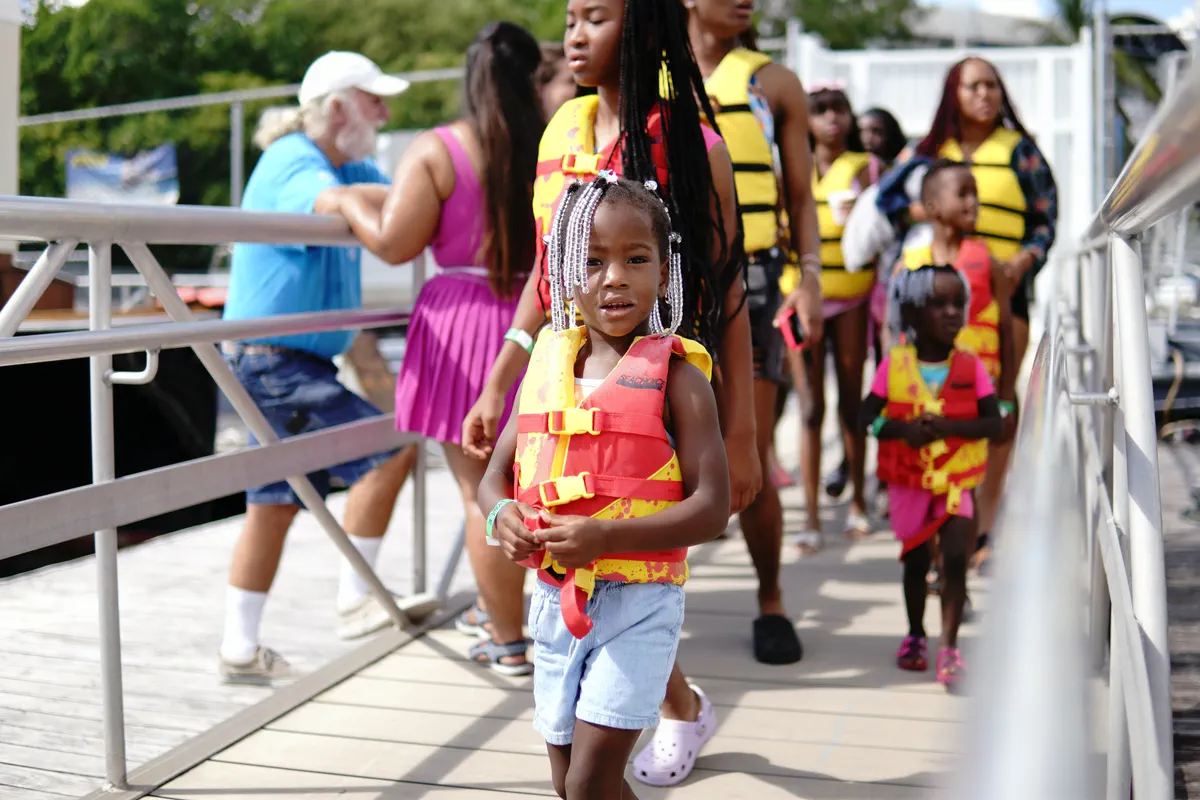
Adaptive by design, not by exception
The fleet, the dock and the campus are built so that the answer to “can I do this?” is almost always yes. Nobody waits on the seawall while everyone else goes out.
Fleet
Twenty sailboats, sixty kayaks and a safety fleet — designed or modified so that a wide range of disabilities can get out on Biscayne Bay.
Campus
A 1932 hangar, a three-story watersports building and a dock you can roll onto. The facility’s accessibility details were mapped independently by Wheel The World.
Team
Staff trained to work with a wide range of support needs, and certified in water safety, CPR and boating safety. Since 1996, University of Miami physical therapy students have taken their Integrated Sports and Leisure elective with us.
Cost
Most sessions are free or heavily subsidized. For summer camp, the majority of participating children attend at no charge, paid for by The Children’s Trust and other donors.